
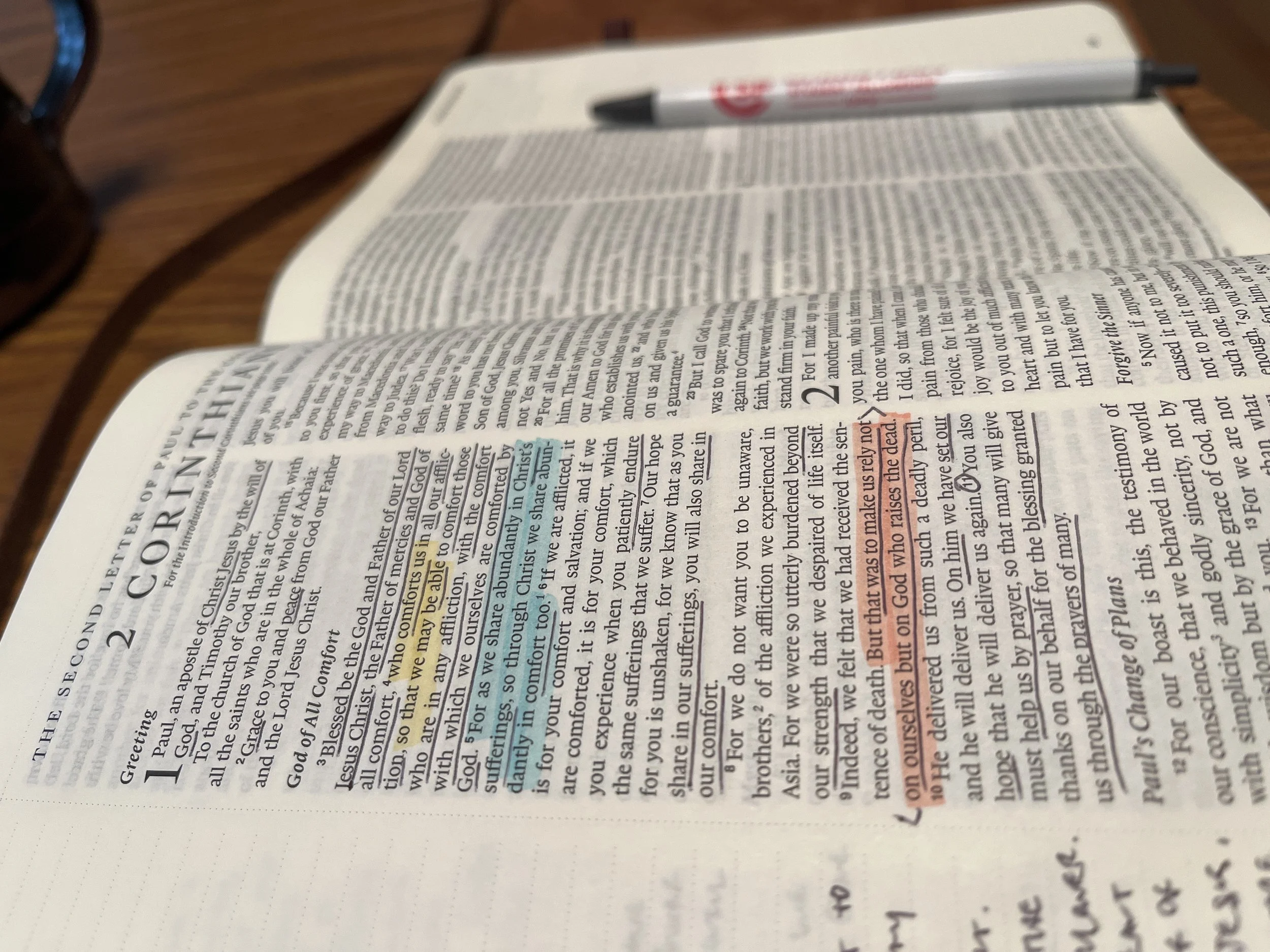
Many Tribulations

Today’s reading: Acts 14:8-28

“strengthening the souls of the disciples, encouraging them to continue in the faith, and saying that through many tribulations we must enter the kingdom of God. And when they had appointed elders for them in every church, with prayer and fasting they committed them to the Lord in whom they had believed.” - Acts‬ ‭14:22-23‬ ‭ESV‬‬

First of all, this is the first place Luke uses the first person ”we” in Acts. He enters his book with a declaration that much suffering will play a role in the life of every follower of Jesus. This wasn't something happening just to someone else. He was involved as well.

The following quote hammers this idea home:

It is almost taken for granted throughout the New Testament that tribulation is the normal lot of Christians in this age: it is those who suffer for and with Christ now who will share his glory. “No cross, no crown.” - F.F. Bruce

We also see in these verses that trials require strong leadership (elders) in the church, reminding us what is true.

Polarizing Preaching

Today’s reading: Acts 13:42-52, 14:1-7

“All who were appointed to eternal life became believers.” - Acts 13:48

Preaching will always be polarizing. Some will be open and believe, while others will refuse and reject the message.

This is probably the main cause for Christians not sharing their faith. The Barna Group has found that almost half of practicing Christian millennials think evangelism is wrong. Could this guarantee of rejection have anything to do with it?

The mob mentioned in verse 30 is enough to frighten any of us. Yet isn’t it worth the risk for the some who are appointed to eternal life?

Sharing the grace and truth of Jesus is risky. It exposes us to shame and humiliation — but isn’t this what Jesus himself endured even while on the cross? (see Isaiah 52:12-Isaiah 53:12)

Being identified with the Savior of the World should make us feel privileged and honored.

Some will never understand.

Yet we have to keep bouncing so that some will believe. 💪

God Raised Him

Today’s reading: Acts 13:16-41

"But God raised him from the dead!" - Acts 13:30

One of the reasons this recorded message of Paul is so phenomenal is how he masterfully glides through an assortment of Old Testament prophecies, stringing them all together. From Deuteronomy 1:31 to Psalm 2:7 to Isaiah 55:3 to Psalm 16:10 and then finally to Habakkuk 1:5 -- we are shown how the early disciples made a case for the integrity of their (our) faith from the Hebrew Scriptures.

If Paul can convince this Jewish and Proselyte (Jewish converts) audience of the truth that Jesus had been raised from the dead, he knew it could change everything -- the door to their hearts would be kicked in and they would be readied for Jesus to begin his reign and rule in them.

It's almost as though he's saying, "Let me remove any intellectual issues you have with Jesus." -- "Come, meet the eye witnesses." (13:31)

From beginning to end, the faith of Christ rests on the solid ground of established facts; it does not depend on dreams and visions, nor on logical deductions or intuitions of the human reason; it is built on well-attested facts; - Spence-Jones, H. D. M. (Ed.). (1909). Acts of the Apostles (Vol. 1, p. 414)

Yet a satisfied intellect isn't enough. Surrender has to move from our heads to our hearts.

Saul to Paul

Today’s reading: Acts 12:24-25, 13:1-15

“Then Saul, also known as Paul.” - Acts 13:9

Contrary to the popular opinion of some, Paul’s name was not changed upon his initial conversion to the Christian faith. By this point, it has been around 15 years since his roadside experience with Jesus and his subsequent baptism.

So why does Paul leave Saul behind as they embark on their First Missionary Journey?

“As a Roman citizen Paul would have borne three names, the third of which would have been the Latin ‘Paullus’; what his first two names were, we do not know. A Roman citizen could have a fourth name given at birth and used as a familiar name; in Paul’s case this could have been his Jewish name ‘Saul’.” - H.I. Marshall

Paul would stop nothing, short of sinning, to reach the Gentiles. He was not on these mission journeys to pacify, and blend in with, the Jews. Mostly, he angered them.

In 1 Corinthians 9:19-23, he lays it out: “by all means I may save some”.

What simple barriers can we remove in order to better reach the lost?

Consumed

Today’s reading: Acts 12:1-23

“...an angel of the Lord struck Herod with a sickness, because he accepted the people’s worship instead of giving the glory to God. So he was consumed with worms and died.” - Acts 12:23‬

This exact historical event was also recorded by first century Jewish historian, Josephus (Ant. 19:343–350).  He mentions that Herod was “clad in a glittering silver garment” — making it clear that he was so deceived as to think he was a god. To make things worse, he had the ability to revoke access to food.

Josephus also mentions that the pains from this sickness lasted for five days before he died.

Now, we may not be this narcissistic, but we all have had to battle with our own egos. There is something about the sinful nature within us that, if allowed to go on for too long, makes us want to step on others who are “beneath” us or stand in our way to supposed greatness.

Worship is a daily recognition of who is actually in charge.

Give thanks to the God of gods. His love endures forever. - Psalm 136:2

Finding Saul

Today’s reading: Acts 11

“Then Barnabas went on to Tarsus to find Saul.” - Acts 11:25

The experience in Caesarea was just the beginning for Gentiles coming to faith in Jesus. Primitive Christian missionaries from Cyprus and Cyrene made a bold move to go preach in Antioch. This city had experienced rapid growth and became the third largest city in the Roman Empire (around 500,000 people) — only behind Rome and Alexandria.

The Gospel found readied soil there. “Large numbers” is used twice to describe the work there. Barnabas was sent there from Jerusalem and helped to compound the growth.

Yet Barnabas doesn’t become content in the experience. He knows how to blow this thing wide open. He has to get Saul of Tarsus (now 12 years into his Christian life).

How many of us would have wanted to absorb the credit? Barnabas thought much bigger than that, and as we will see from this time on — it would help the entire Roman Empire hear about Jesus.

May we release others into leadership to promote further growth!

Poured Out

Today’s reading: Acts 10:24-48

“Even as Peter was saying these things, the Holy Spirit fell...” - Acts‬ ‭10:44‬

First of all, the message that Peter gives in Acts 10:34-43 is a brilliant and succinct presentation of the Gospel. We would do well to read it on a regular basis for a reminder of what we believe and how we can clearly communicate that belief to others.

Second, God has interrupted Peter talking before (Transfiguration: Matthew 17:5) and He does it again here. Luke uses the same language from Joel 2:28-32, “poured out”, to indicate that this was the same experience as happened in Acts 2.

Would there have been any other way to show the Jewish Christians that Gentiles were a part of God’s plan as well?

We see here, as in Acts 2, that the external manifestation of the Holy Spirit was evidence that they were worthy to receive the indwelling gift of the Holy Spirit. The sign showed they were worthy to be sealed, saved, set apart.

The Holy Spirit will make the difference as we share Jesus’ love with others.

Without Hesitation

Today’s reading: Acts 10:1-23

“Get up, go downstairs, and go with them without hesitation. Don’t worry, for I have sent them.” - Acts 10:20‬

No one knows what fallen humans are really like — except God Himself. He knows who He created us to be, and He knows what we have become as a result of our sin. In our fall state, it is natural for us to reject something that is different from what we are accustomed.

God was about to break down a barrier that had held for so long among Jews: NO GENTILES ALLOWED.

Plato was the first to speak of this, but this quote is revealing:

Tosefta Berakhot 6:18 teaches in the name of Rabbi Yehuda ben Ilai (mid-2nd c. CE) that every (Jewish) man is obligated to recite three blessings daily. These express gratitude for ones station in life through the negative statements: thank God that I am not a gentile, a woman, or a slave. - Ruth Langer

Prejudice is something that can run deep, undetected.

May we never hesitate to embrace every nation, tribe, people, and tongue! (Revelation 7:9)

Numbers

Today’s reading: Acts 9:26-43

“The church then had peace throughout Judea, Galilee, and Samaria, and it became stronger as the believers lived in the fear of the Lord. And with the encouragement of the Holy Spirit, it also grew in numbers.” - Acts 9:31‬ ‭NLT‬‬

This pattern of growth is a great way to be praying for the local church we are attending:

1) Peace >> environment of unity within

2) Strength >> to be built up — this will be a process

3) Fear of the Lord >> we worship God alone and are not intimidated by those without

4) Comfort of the Holy Spirit >> encouragement to continue to build — to stick with it (comes alongside)

5) Numbers >> this is the overflow of a healthy church — we don’t want this without the previous four

When we pray for our local church to grow, may we ask God to increase our numbers the right way.

One interesting question to ask is: “Does the Jerusalem church experience these five without the proper handling of Saul’s arrival?

This is why the work of Barnabas is even more impressive.

More and More

Today’s reading: Acts 9:1-25

“Saul’s preaching became more and more powerful...” - Acts 9:22

This opening phrase is actually one word in the Greek: ἐνδυναμόω endynamoō and it means to “strengthen”, “become strong”, or “cause to be able”.

Saul’s communicative ability had always been high as a Pharisee. It was his life’s work. Yet now there was something that had shifted in the way he was speaking. The Hebrew texts that he had memorized and poured over for so long were now soundly proving Jesus as the Messiah.

This may remind us of the description for Jesus’ teaching when compared to the religious leaders:

“He taught as one who had authority...” (Matthew 7:29). 

It wasn’t just an excitement in their voices. It was authoritative, it was obviously of divine origin.

Do you think God could use your voice in such a way? He has for centuries in ordinary people like you.

Check this out:

The filling of the Spirit which he had received gave his words a demonstrative power which could not be confuted. - F.F. Bruce

💪