
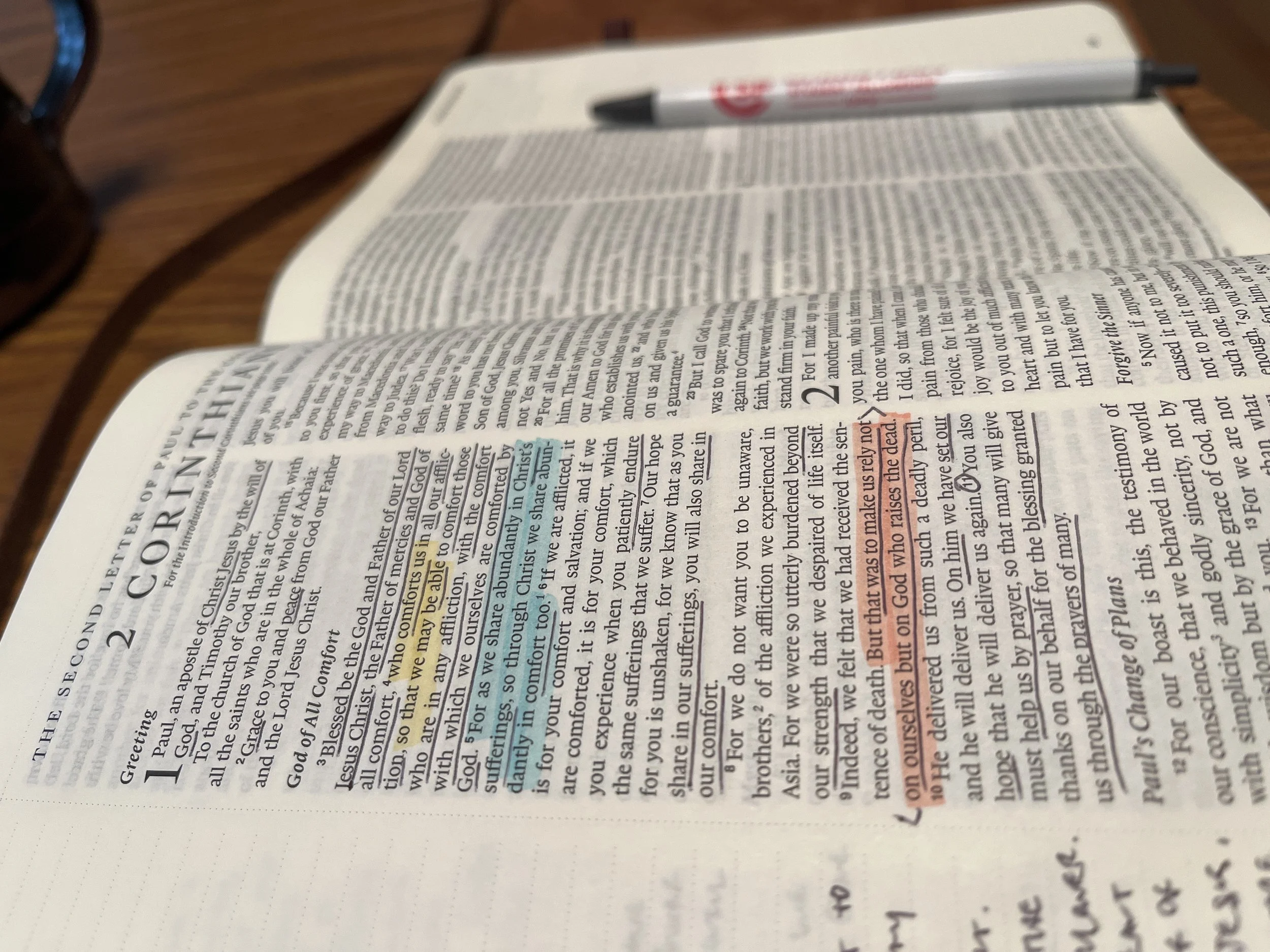
All the Books Cannot Contain

Day 153: John 21:1-25

“Now there were many other things that Jesus did. Were every one of them to be written, I suppose that the world itself could not contain the books that would be written.” - John 21:25 ESV

We've come to the end of our reading of the four biographies of Jesus' life and ministry. Many throughout history, and even today, struggle with what isn't included in these four accounts. It has been said that if you stretched out the scroll of John's gospel it would stretch ninety feet, and yet many of us wish there were at least ninety-two.

John's final statement doesn't help us if we're feeling this way. So many interactions and healings and teachings that we know nothing about. It is clear what we want. We want to know more about Jesus. Yet John, in his own way, is telling us that we have everything we need in what has been written.

What do we need to know to experience eternal life?

  • Jesus is the Son of God (John 1:1-5)

  • Jesus desires us to be born again (John 3:3-5)

  • Jesus was on a love-driven rescue mission (John 3:16-17)

  • Jesus was crucified for our sins (John 19:30)

  • Jesus was raised (John 20:1-10)

Our job? To worship this Jesus daily. To share His Good News with everyone we encounter.

We have all we need.

"He ends with an expression of human inadequacy. We can never know or appreciate Christ enough. The splendor of Christ surpasses and eludes our senses and abilities or capacities. The Gospel of John ends with Christ’s triumphs, his power, and his grace." - Bryant, B. H., & Krause, M. S. (1998). John (Jn 21:25)

Kathy GarnerComment
A Real Resurreciton

Day 152: John 20:1-31

“Then the other disciple, who had reached the tomb first, also went in, and he saw and believed; for as yet they did not understand the Scripture, that he must rise from the dead.” - John 20:8-9 ESV

First of all, how funny is it that John (who is now elderly as he writes) felt the need to slip in the detail about him smoking Peter in a foot race to the empty tomb? As men grow older, their need heightens to let others know of their athletic feats.

Have you ever thought about how the early disciples of Jesus were able to help prove Jesus' resurrection via the Hebrew Bible? For the first 20 or so years of the church, the New Testament as we know it didn't exist (James and Galatians were probably written around 50 AD). Of course, having eyewitness testimony didn't hurt their ability to convince people concerning the empty tomb!

In Acts 13:32-38, the Apostle Paul gives us a glimpse of the passages he used (Psalm 2:7, Isaiah 55:3, Psalm 16:10).

Jesus' resurrection is proof that the "everlasting covenant" (Isaiah 55:3) that was first introduced to the Jews is alive and well today.

This is yet another example of the commitment and investment God has made into His church today.

Jesus lives now to pray for us, to see us through to the end of our lives or His second coming (whichever comes first; see Hebrews 7:25).

"It is important to note the emphasis John and other NT writers place upon the importance of the empty tomb. For them the resurrection of Jesus was certainly not just ‘spiritual’ survival after death; it involved a real resurrection of the body." - Kruse, C. G. (2003). John: An Introduction and Commentary (Vol. 4, p. 370)

Kathy GarnerComment
Bring Us to God

Day 151: John 19:23-42

“When Jesus had received the sour wine, he said, ‘It is finished,’ and he bowed his head and gave up his spirit.” - John 19:30 ESV

Even as Jesus is in His final moments, He's still fulfilling Messianic prophecies from the Hebrew Bible. In our short reading for today, John mentions four of these prophecies:

Psalm 22:18 - "They divided my garments."

Psalm 69:21 - "I thirst."

Psalm 34:20 - "He protects all his bones, none broken."

Zechariah 12:10 - "They will look on the one they have pierced."

John's primary objective in writing this fourth biography is to show us (without a doubt) that Jesus was indeed the Son of God. Even as Jesus is drawing His final breaths, we see that He is in more control of these moments than His opponents can even begin to know.

These events were so impressive that they caused two Pharisees to go from private to public with their faith in Jesus (Joseph and Nicodemus).

How about you? Are you ready to submerge yourself in the events of the cross, to trust this crucified Jesus for salvation?

One of Jesus' original disciples, Peter, said it so well: "For Christ also suffered once for sins, the righteous for the unrighteous, that he might bring us to God." - 1 Peter 3:18

Check out this page if you’re ready to take your next faith step toward Jesus today.

Kathy GarnerComment
You Say that I Am a King

Day 150: John 18:25-40, 19:1-22

“Then Pilate said to him, ‘So you are a king?’ Jesus answered, ‘You say that I am a king. For this purpose I was born and for this purpose I have come into the world— to bear witness to the truth. Everyone who is of the truth listens to my voice.’ Pilate said to him, ‘What is truth?’ After he had said this, he went back outside to the Jews and told them, ‘I find no guilt in him.'” - John 18:37-38 ESV

Everything that Jesus did bore witness to the truth. Nothing He did was unintentional. Pilate was having trouble wrapping his mind around the concept of truth, and many of those in our culture today are having the same struggles.

We want to make allowances for people to float through life however they desire, even if it may lead to destruction. Yet, the problem with everyone creating their own truth is that it causes mass confusion. Nobody really knows who they are anymore, at least for more than three days at a time. For me, this is my great fear. What if I live a majority of my life and end up wasting it with an everything-is-relative mentality?

Jesus knew who He was, and He also wants us to be sure of who we are.

The word used for truth is the Greek word ἀλήθεια alētheia, and Louw and Nida translate it as the content of that which is true and thus in accordance with what actually happened.

Who gets to decide what reality looks like? Us? Finite, created beings? Or perhaps we should let our Creator take the lead on this one. Jesus has given us every reason to believe that we can trust Him.

"Pilate wanted an acknowledgment from Jesus that he was a claimant to worldly kingship. Jesus refused to be pinned down in this way. Instead, he said he came as a witness to God’s truth, a witness to the coming kingdom of God, and informed Pilate that Everyone on the side of truth listens to me. Thus he challenged Pilate to stop listening to the manufactured charges of his accusers and start listening to him. In this exchange of challenge and riposte Jesus emerged as victor and Pilate was reduced to confusion: ‘What is truth?’ Pilate asked." - Kruse, C. G. (2003). John: An Introduction and Commentary (Vol. 4, p. 354)

Kathy GarnerComment
Jesus Crossed the Kidron Valley

Day 149: John 18:1-24

"After saying these things, Jesus crossed the Kidron Valley with His disciples..." - John 18:1

This may be a verse we would normally pass by on our way to the Garden scene, but it has a ton of significance in regards to it being the time of Passover. The following quote gives us vivid imagery of the scene:

“All the Passover lambs were killed in the Temple, and the blood of the lambs was poured on the altar as an offering to God. The number of lambs slain for the Passover was immense. On one occasion, thirty years later than the time of Jesus, a census was taken, and the number was 256,000. We may imagine what the Temple courts were like when the blood of all these lambs was dashed onto the altar. From the altar there was a channel down to the brook Kidron, and through that channel the blood of the Passover lambs drained away. When Jesus crossed the brook Kidron, it would still be red with the blood of the lambs which had been sacrificed; and as he did so, the thought of his own sacrifice would surely be vivid in his mind.”  - Barclay, W. (2001). The Gospel of John (Vol. 2, p. 258)

Some also say that the bed of the Kidron Valley was permanently stained by the blood of the lambs that were sacrificed. In verse four, we see that Jesus "fully realized all that was going to happen to Him" -- this is all starting to sink in. This is after he has prayed, "not my will, but yours be done" in the Garden.

What Jesus did for us on the cross was not just intense physically, it was also intense mentally. He had known the plan, but now he was going to experientially know the plan, which was more painful than anyone could have ever imagined. 

This gives a new feel to the following verses (also written by John):  

“These are the ones coming out of the great tribulation. They have washed their robes and made them white in the blood of the Lamb.” - Revelation 7:14

“They triumphed over him (Satan) by the blood of the Lamb.” - Revelation 12:11

Jesus, thank you for being our sacrificial Lamb, doing for us what we could never do on our own.

Kathy GarnerComment
Becoming Perfectly One

Day 148: John 17:1-26

“I in them and you in me, that they may become perfectly one, so that the world may know that you sent me and loved them even as you loved me.” - John‬ ‭17:23‬ ‭ESV‬‬

Jesus’ high priestly prayer here in John 17 should make us emotional. He prays for His disciples, He prays for us, and He prays for the entire world.

The thing that broke my heart as I read this chapter is the insistence Jesus had on us remaining ONE. You don’t have to talk to Christians for five minutes to see that we haven’t done an excellent job of staying together.

Why do you think Jesus saw this as being so important?

He knew that this would be one of the main ways our enemy, the devil, would work to disrupt our mission of spreading the good news about Jesus.

How can we do a better job at being unified as a church? Listen more. Talk less. Cry with people and work to understand their perspective instead of choosing to slander.

Our knee-jerk reaction will always bend towards pride and a desire to be right. May God help us to shift toward being teachable and humble in all our interactions with fellow Jesus followers. 

There is always more going on than we can see and hear in people’s lives. We just have to stop for a bit to pay attention.

The fruit that follows unity is unmatched.

"The spiritual union of Christendom in its one faith, hope, and character, is, notwithstanding the divergence of some of its forms of expression, the most stupendous fact in the history of the world. The élite of all Churches are drawing more and more into a visible unity."  - Spence-Jones, H. D. M., ed. (1909). St. John (Vol. 2, p. 351)

Kathy GarnerComment
You May Have Peace

Day 147: John 16:1-33

“I have said these things to you, that in me you may have peace. In the world you will have tribulation. But take heart; I have overcome the world.” - John 16:33 ESV

In this farewell discourse (John 14-17), Jesus' goal was to prepare His disciples for what was coming. Any time we step into a new season, it can be easy to start panicking about all the unknowns. In their case, they were understandably disturbed at His insistence on the fact that He was going away, yet coming back, then going away (again).

Jesus wanted his disciples to have peace (eirene), literally, perfect calm. Yet He says they should have an expectation of tribulation (other translations read trouble). How can these two things co-exist? It is obvious that Jesus is saying that this is the reality for anyone who wishes to follow Him.

It isn't going to be easy. Actually, many will die for their faith in Jesus. Yet, at the same time, this is going to give you a deep-down peace that no one can come close to replicating or administering. Only God can consistently calm our souls.

Expect trouble.

Expect peace.

Walk with Jesus, led by the ever-present help of the Holy Spirit.

Live the good life.

"The Greek verb translated overcome is νικάω (nikaō). It is related to the name of Nike, the Greek winged goddess of victory. It means to ‘win a victory’ or to ‘conquer.’ ‘Overcome’ conveys this idea, but on a smaller scale than the Greek verb suggests. This is the word of triumphant generals and emperors, of world conquerors. It is a word for the Julius Caesars and the Alexander the Greats of the world. And it is directed against the current king of the hill, the “prince of this world” (Satan, v. 11). By cheating death Jesus demolishes the chief stranglehold of fear that Satan maintains over humanity (see 1 Cor 15:26)." - Bryant, B. H., & Krause, M. S. (1998). John (Jn 16:33)

Kathy GarnerComment
The Way to Bear More Fruit

Day 146: John 15:1-27

"Every branch in me that does not bear fruit he takes away, and every branch that does bear fruit he prunes, that it may bear more fruit." - John 15:2 ESV

When we first read this verse, we may be a little disappointed. Why would a fruitful branch (us) of the vine (Jesus) be pruned by the gardener? The following quote from Bryan/Krause's commentary hits deep:  "If left untrimmed, a grapevine will use its available energy to grow long woody branches and extend its territory, while producing a few meager bunches of grapes."

God isn't interested in us spanning into a less fruitful season after He's done so much in and through us. Instead, He is looking to trim us back so that we can produce even more fruit as we remain in Him. Jesus is the only one who truly knows all our capabilities.

The word remain is used seven times in the first eight verses of our reading for today. It is the Greek word menō, and it can also be translated as stay or abide. I love the imagery of staying. 

There is no other place we can go where we can become who we are truly meant to be. 

Remaining with Jesus means that we can maximize our influence in this world.

Don't be alarmed by the trimming. It may be painful or inconvenient, but God knows what He is doing. The proof will be in the fruit that follows for years to come.

Kathy GarnerComment
Love, Obey, Thrive

Day 145: John 14:15-31

“If you love me, you will keep my commandments. And I will ask the Father, and he will give you another Helper, to be with you forever." - John 14:15-16 ESV

These two verses are some of the most powerfully practical that you'll find in all of John's Jesus biography. Three things immediately jump out as we look a little deeper:

#1 LOVE - Relationship needs to precede right living. Before we step into a life of obedience to Jesus, we need to establish a healthy relationship with Him. We love and trust Jesus first and foremost. We can depend on Him! How has your prayer life been lately?

#2 OBEY - Obedience isn't optional; it is to be expected. As we love and interact with Jesus, our lives will be transformed. This is manifested in the way that we serve our families and those around us. It is even shown in the way we love our enemies. The Apostle Paul described it as, "...the obedience that comes from faith." (Romans 1:5, NIV)

# 3 THRIVE - Does this seem daunting? Feel inadequate to accomplish what God is asking you to do? Never fear. The Holy Spirit is our Helper (parakletos - advocate). Where we are insufficient, He is more than enough to make us adequate.

Don't you love how intentional Jesus was in using these final moments to prepare His disciples for what was to come? He is doing the same for us today. May we move forward with the God of all creation on our side. We can't lose.

"It is somewhat startling to find the great promise that follows conditionated by loving obedience, seeing that love and obedience in any sinful man, love to Christ itself, are elsewhere made the work of the Holy Spirit. But we here come across that which often perplexes the student, viz. the contrast between the general idea of the constant and continuous work of grace in human hearts, and the special manifestation in personal glory and Divine activity of the Holy Ghost on Pentecost." - Spence-Jones, H. D. M., ed. (1909). St. John (Vol. 2, pp. 225–226)

Kathy GarnerComment
If You Have Love

Day 144: John 13:31-38, John 14:1-14

“A new commandment I give to you, that you love one another: just as I have loved you, you also are to love one another. By this all people will know that you are my disciples, if you have love for one another.” - John 13:34-35 ESV

This is the first of three instances where Jesus commands His disciples to love one another (13:34, 15:12, 17), but this one is unique in the fact that He calls it a new command.

What was so new about this command? The Law of Moses commanded them to love their neighbor as themselves (Leviticus 19:18), but Jesus ratchets the expectation way up. He is asking His disciples (and us) to love each other in the way that He loved them. A love that serves. A love that gives. A love that self-sacrifices for the good of others. A love that forgives. A love that confronts injustice.

We soon realize that this kind of love will not be something that we can master in 20 years of practice. We will always be working on it.

Also, Jesus said that it should be our main signifier to the outside world that we know and follow Him. Unfortunately, this isn't what we are known for most in the world today. But the result of certain Christians obeying this command over the past 2,000 has literally changed the world in more ways than we have room to talk about here.

From the abolition of slavery to gender equality to care for the poor, Christians have always led the way in loving and caring for all.

Your turn.

"The new commandment was love for one another. It would hold them together and mark them as disciples of Jesus. Even so are we bound together and marked today." - Foster, L. (1987). John: Unlocking the Scriptures for You (p. 151)

Kathy GarnerComment