
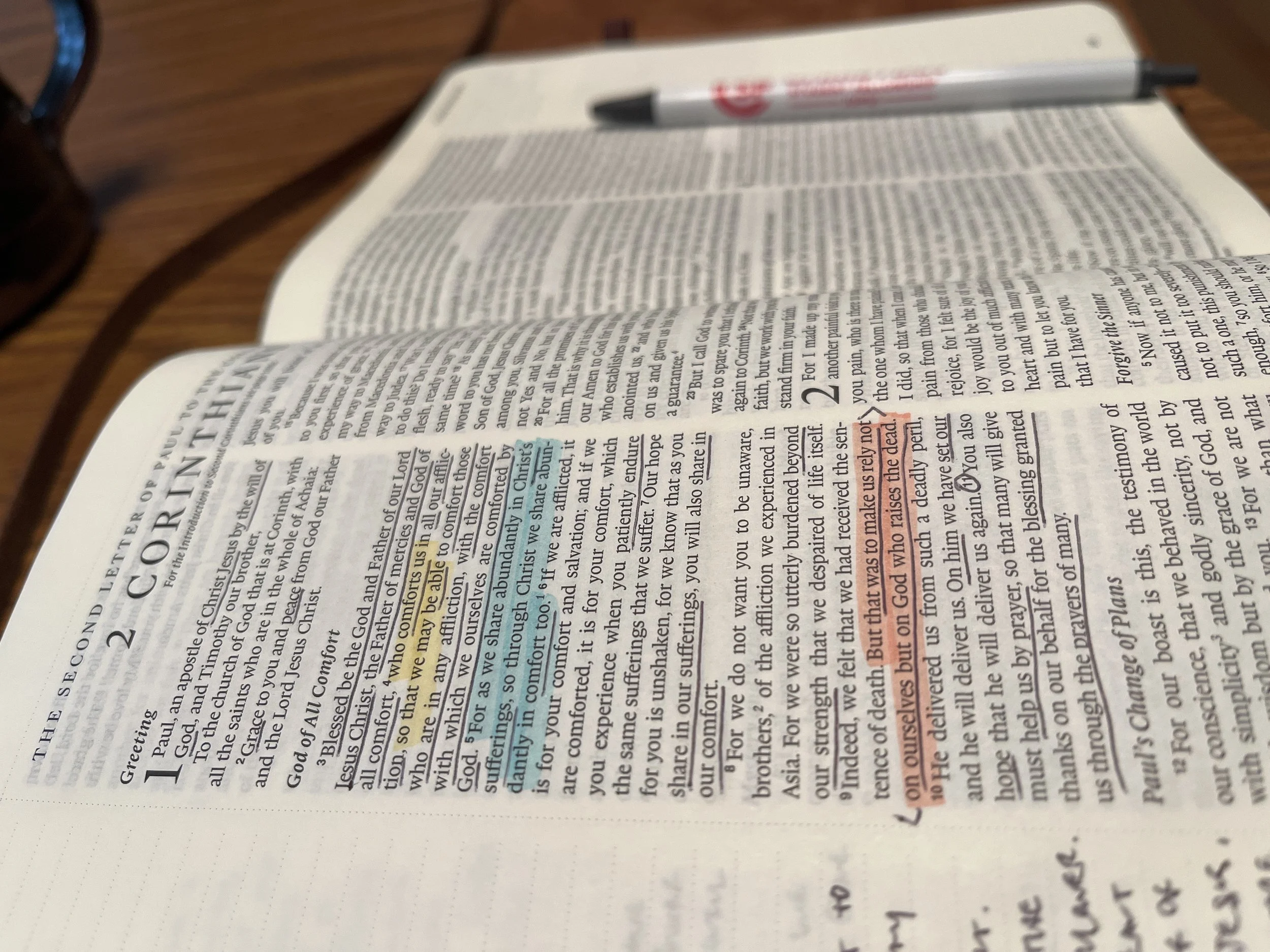
Your Attitude

Today’s reading: Philippians 1:27-30, 2:1-18

“You must have the same attitude that Christ Jesus had.” - ‭‭Philippians‬ ‭2:5‬ ‭NLT‬‬

The word used for attitude here is φρονέω phroneō. Jesus uses the same word in Matthew 16:23 when he calls Peter “Satan,” and says that he doesn’t have his “mind/phroneo” set on the things of God, but the things of man.

So what does it practically look like to think like Jesus thought when he was in the flesh, on earth? Verses 6-18 lay it out for us.

It has to do with a whole lot of selflessness. It isn’t a downgrading of our value. Instead, it is using all of our worth to pour ourselves out for the sake of others.

When we think like Jesus thought, and thus live as Jesus lived, we will stand out like stars in the darkness.

There will never be a shortage of crooked and perverse (selfish) people. So when we put this all into practice, all we do will be a strong witness of the gospel.

Yes, it will be a lot of work, but God will give us the desire and power to see it through (verses 12-13).

CSF IndianapolisComment
The Finisher

Today's reading: Philippians 1:1-26

'And I am sure of this, that he who began a good work in you will bring it to completion at the day of Jesus Christ.' - Philippians 1:6 ESV

An inability to finish has to be one of our most significant flaws as humans. We start a book, only to never make it past the second chapter. We get into a home project, only to run out of steam when it requires getting on a ladder. We resolve to read our Bibles and pray daily, then a week goes by, and we realize we haven't read a single word or prayed a single prayer.

God isn't just a starter; he's also a finisher. Yet the way he finishes is a little different from the way we usually think of checking something off of our list. He sees what he is doing in us as a process. The Bible calls this sanctification (see 1 Thessalonians 4:3-5).

C.H. Spurgeon, writing about this verse, put it this way:

"Granted an immutable God, we may be sure that grace will complete what grace begins."

God is committed to our growth, and he will never grow tired of that work.

CSF IndianapolisComment
No Favorites

Today’s reading: Ephesians 6

“And masters, do the same things to them, and give up threatening, knowing that both their Master and yours is in heaven, and there is no partiality with Him.” - Ephesians‬ ‭6:9‬ ‭NASB‬‬

Slavery in the Bible is something that is difficult to stomach, especially as we read the New Testament. Why didn’t Paul say, “Alright! Enough! Slavery is done among Christians. Let them be free!”?

Here in Ephesians 6 we see what Paul (the Holy Spirit) was doing in the area of slavery (and for all who were marginalized). Groundwork was being laid for every culture to recognize the intrinsic truth that all have been created equal in God’s sight.

God doesn’t favor anyone more than another.

This was a revolutionary thought in the first century, and it is still splitting heads today. The rich. The poor. Male. Female. The famous. The forgotten. All of us matter to God. There is no ranking system in play within Christianity.

Abolition of slaves was initiated by verses like these.

God doesn’t play favorites.

CSF IndianapolisComment
Thankfulness as a Weapon

 Today’s reading: Ephesians 5

“Let there be no filthiness nor foolish talk nor crude joking, which are out of place, but instead let there be thanksgiving...giving thanks always and for everything to God the Father in the name of our Lord Jesus Christ.” - Ephesians‬ ‭5:4, 20‬ ‭ESV‬‬

It is wild that, from Paul’s perspective, the best way to combat the darkness in our lives and our churches is thankfulness from our mouths.

In between the verses above, we also see the exciting quotation in verse 14: “Awake, O sleeper, rise up from the dead, and Christ will shine on you.”

F.F. Bruce has an interesting note on this verse:

“The wording may well be that of a primitive Christian baptismal hymn (cf. the early description of baptism as φωτισμός, “enlightenment”); the very rhythm of the three stichoi is of a type associated in the Greek memory with religious initiation.”

Again, we see here that thankfulness and praise and hymns were foundational to consistently stepping into the light.

Choose to sing today, thankfully!

CSF IndianapolisComment
Distressing the Holy Spirit

Today's reading: Ephesians 4:17-32

'And do not grieve the Holy Spirit of God, by whom you were sealed for the day of redemption.' - Ephesians 4:30 ESV

The Greek word used for grieve here is lypeo, and it means to cause someone to be sad, sorrowful, or distressed. This seems to be the only place this word is used in reference to God (specifically, the Holy Spirit). Why would God use such a human word to describe how he feels when we make poor decisions, especially with the way we speak?

Again, God is giving us something with which we can relate.

All of us have experienced grief in some form, and many times it shows itself after we've felt the sting disappointment or pain. The same word is used in 1 Thessalonians 4:13: "...that you may not 'grieve' as others who have no hope."

So how can we keep from making the Holy Spirit distressed?

Paul lays it out when he says in verses 22,24: "put off your old self...and put on the new self." Don't climb back into the corpse of anger and hateful speech. Step into a better life with Jesus.

CSF IndianapolisComment
Proper Working

Today's reading: Ephesians 4:1-16

'Rather, speaking the truth in love, we are to grow up in every way into him who is the head, into Christ, from whom the whole body, joined and held together by every joint with which it is equipped, when each part is working properly, makes the body grow so that it builds itself up in love.' - Ephesians 4:15-16 ESV

First, speaking the truth in love seems to be a lost art form today.

Second, I wonder what would happen in the church if every one of our members really believed verse sixteen. It is the belief that we all have pivotal roles to play, that we will be purposefully stunting the growth of the church by refusing to play our part.

Does your part matter? I mean, what is your part? How can you know what it is?

Two things:

1) Stay attentive >> God is always working. We just have to pay attention to what he may be doing, and then step into it.

2) Stay ready >> When God reveals what part you need to play, you need to be ready to say, "yes."

Then watch the church grow as God uses you.

CSF IndianapolisComment
Rooted and Grounded

Today's reading: Ephesians 3

'...so that Christ may dwell in your hearts through faith—that you, being rooted and grounded in love, may have strength to comprehend with all the saints what is the breadth and length and height and depth, and to know the love of Christ that surpasses knowledge, that you may be filled with all the fullness of God.' - Ephesians 3:17-19 ESV

Agape is the word Paul uses here for love. More than any other thing that comes from the hand of God, this is the one that makes us either rise or fall. This is probably because we are constantly in need of its refilling. When we run dry on love, we start treating others like objects to be used. When we lack love, we start looking to God like a cosmic vending machine. If people, or God, don't give us what we want, we land in disappointment and bitterness.

Yet when we are rooted and grounded in love, we see people as image bearers of God. We also start to see God as a loving Father, wanting what's best for us.

Paul is right. Jesus' love surpasses knowledge!

CSF IndianapolisComment
The Rich Redeemer

Today's reading: Ephesians 2

'Even when we were dead in our trespasses, made us alive together with Christ— by grace you have been saved— and raised us up with him and seated us with him in the heavenly places in Christ Jesus.' - Ephesians 2:5-6 ESV

How much grace does God have available to pour out on us? Is there a threshold that he won't cross? Will he ever withhold it because of scarcity or his impatience with us?

In this letter to the church in Ephesus, Paul continues to use some variation of the Greek word plousios to describe God's great grace. We see it in our translations as "rich." Another translation can be "in abundance."

God's grace is opulent, and his storehouse that contains it is always full.

God's grace is the secure foundation that allows us to respond in faith. When we respond with that trust in Jesus, God does his best work, his resurrecting work.

There are so many people walking around today that are animated, but they are dead in their sin. God is waiting with his grace to set them free.

CSF IndianapolisComment
Jesus Knew

Today's reading: Ephesians 1

'Even as he chose us in him before the foundation of the world, that we should be holy and blameless before him. In love he predestined us for adoption to himself as sons through Jesus Christ, according to the purpose of his will.' - Ephesians 1:5 ESV

How long has God had you on his mind? When did he know that you would come to faith in his Son, Jesus? According to this verse, before God said, "Let there be light," he knew you would be saved toward a new life.

Ephesians 1 could be re-read 100x in one sitting and still have more to give us as food for the depths of our souls.

The exciting thing to think about, coming out of this passage, is that there are more that God knows will turn to him in faith for salvation from their sin. The troubling thing is that we don't know who will say "yes" to Jesus. God does. We don't. We don't have foreknowledge like God does (as he exists outside of time).

The pre-Christians are out there. Let's go find them, and then tell them they are invited.

CSF IndianapolisComment
Burdens and Loads

Today's reading: Galatians 6

'Bear one another’s burdens, and so fulfill the law of Christ.'
'For each will have to bear his own load.'
- Galatians 6:2, 5 ESV

These two verses have been pointed to as an apparent contradiction by many skeptics, but we know better than for Paul (the Holy Spirit) to make such a mistake three verses apart.

Should we allow others to help us along the way, or should we go solo and hope for the best?

The word for "burdens" is baros and describes the hardship of working daily.

The word for "load" is pholtion and describes a heavy object that is carried as cargo on a ship.

Every day we should look for opportunities to help someone along the way (see verse 10), but we should note that we all have a personal responsibility as well. We will not be able to carry someone else into heaven.

Each of us has our own heavy cargo, and we cannot look to others to do the work for us. In this instance, we have to look to Jesus, the only one who can make us safe (justification) and sound (sanctification).

CSF IndianapolisComment